Real leadership means choosing people over politics.

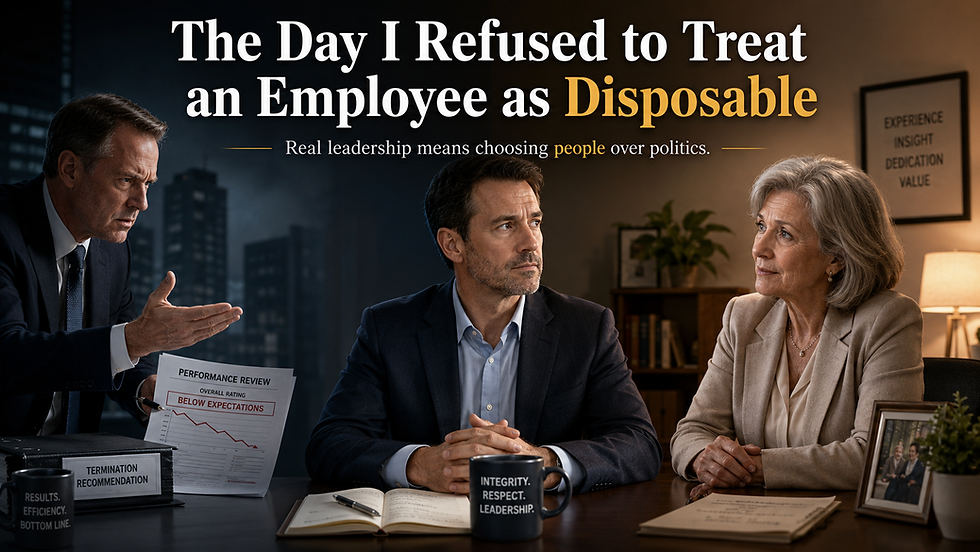
I inherited a brand-new team after my company merged with another organization.
Some of the people I knew.
Some I did not.
My new boss was also someone I did not know. He was a nice enough person, but he did not give much direction or guidance.
About eight months later, it was time for annual performance reviews.
One person on my team was a woman in her mid-60s. She had a reputation for being difficult. She was opinionated. She asked a lot of questions. She could be mildly argumentative.
But I saw something different.
I found her refreshing.
She did not just accept things because someone told her to. She questioned the status quo. She wanted things to make sense. She cared enough to speak up.
Over time, our relationship improved because I gave her room to express her concerns, share her opinions, and vent when she needed to. She knew I would listen. She also knew I would not punish her for being honest.
When it came time to write her review, I gave her the appraisal I believed she had earned. It was a good review, with constructive feedback and clear goals for growth.
When I showed it to my boss, he told me I needed to grade her down and move her out of the company.
I asked why.
His answer was simple: “She is not valuable to the organization.”
That did not sit right with me.
In the eight months she had reported to me, she had helped me understand the work, the history, the problems, and the critical issues that had been ignored for far too long.
She had value.
Maybe she was not always easy.
Maybe her delivery needed work.
Maybe her reputation had followed her.
But none of that meant she deserved to be pushed out unfairly.
The message from my boss was clear.
Either I moved her out, or someone else would do it for me.
So I sat down with her.
I gave her the review as I saw it. I was honest with her about the expectation I had been given. She was not shocked, but she was deeply concerned that she was about to lose her job.
I told her I was not going to follow that directive because I did not believe it was right.
Then I went to work.
I started reaching out to other managers to see if there was a better place for her skills. One after another, they said no. Her reputation scared them off.
Finally, I found a seasoned leader who was willing to take a chance.
I believed they would work well together because both of them were detail-oriented, serious about doing things the right way, and committed to quality work.
When my boss received the transfer paperwork, he was angry.
He asked why I had not followed his direction.
My answer was simple:
“She is not your problem anymore, so why do you care where she goes? I do not treat people like that, and dismissing her would have been completely wrong.”
That moment has stayed with me.
Leadership is not only about managing performance.
It is also about protecting fairness.
It is about seeing the person behind the reputation.
It is about knowing the difference between someone who is truly a problem and someone who simply needs to be heard, guided, and placed where they can succeed.
Not every difficult employee is a bad employee.
Sometimes they are frustrated.
Sometimes they are misunderstood.
Sometimes they have been labeled so long that no one takes the time to look again.
A leader’s job is not to blindly carry out someone else’s unfair decision.
A leader’s job is to do what is right, even when it is uncomfortable.
People are not disposable.
And leadership should never treat them like they are.