Before We Blame Gen Z, Maybe We Should Understand Them...


I hear a lot of leaders talk about Gen Z. “They don’t know how to communicate.” “They don’t want to come into the office.” “They’re always on their phones.” “They don’t know how to have a difficult conversation.” “They don’t build relationships the way we did.”
Maybe. But I think we’re asking the wrong question.
Instead of asking, “What’s wrong with this generation?” perhaps leaders should be asking, “What happened during the years when this generation was learning how relationships work?”
That changes the conversation considerably.
Think About What We Learned Without Realizing We Were Learning It
I grew up in a very different world. Many of us from previous generations learned how to communicate because we had little choice. We sat across from people. We talked on the telephone. We disagreed face-to-face. We learned to read expressions, recognize when someone's demeanor changed, work through awkward silences, apologize, shake hands and figure out how to coexist with people we didn't necessarily like.
Nobody called it “developing interpersonal skills.” It was simply life.
We developed relationship skills through thousands of little interactions over many years. Some went well. Some went horribly. But every one of them taught us something about people.
Now consider what happened to many members of Gen Z. For some in this generation, COVID hit during their teenage years, high school, college or just as they were starting their careers. These are times when people are still learning how to build relationships, become independent and develop social skills.
Schools closed. Activities disappeared. Graduations were canceled or moved online. College campuses emptied. Internships changed. Churches, restaurants and gathering places shut down or restricted interaction. Conversations that would normally happen across a lunch table suddenly happened through a screen.
Research conducted during the pandemic documented significant reductions in young people's everyday social interactions and disruptions to peer relationships.
Adolescence is an especially important period for social development, and researchers found that pandemic restrictions substantially changed how young people interacted with their friends and families.
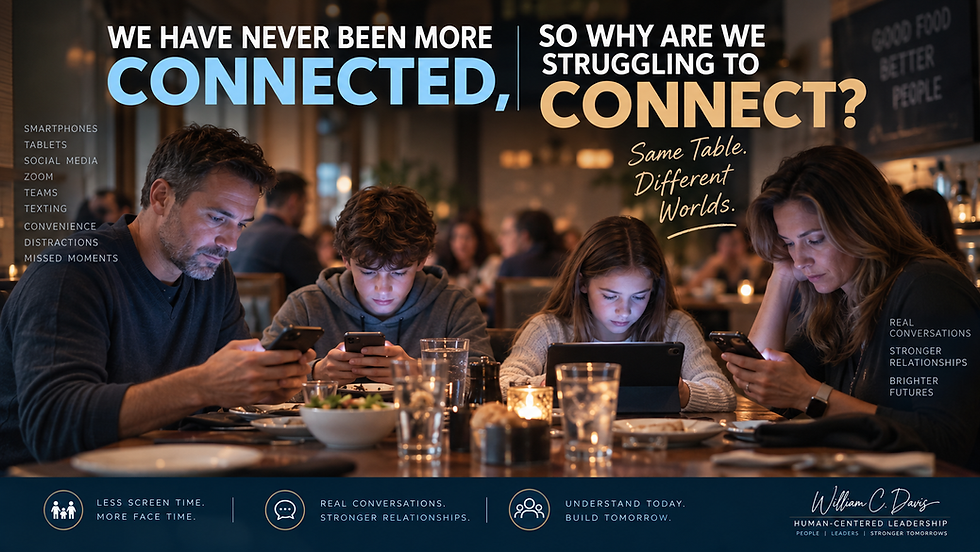
Technology became the bridge, and thank goodness it did. But using technology to connect is not the same as actually being together. Pew Research found that most Americans ultimately viewed virtual interaction as useful during the pandemic, but not a replacement for being together in person.
That distinction matters.
They Didn't Stop Developing. They Developed Differently.
This is where I think leaders from my generation need to be careful. It is very easy to judge someone based upon the experiences that shaped us, while never considering the experiences that shaped them.
We sometimes look at a 24-year-old employee and expect them to possess the same comfort with interpersonal communication that we had at 24. But did they have the same opportunities to develop it?
This doesn't excuse poor communication, avoiding responsibility or an unwillingness to work with others. Every new generation entering the workplace has things to learn. But understanding is not excusing. Understanding gives us somewhere to start.
After almost forty years of leading people, I learned that you can't lead anyone well if you don't try to understand them. Leadership isn't about wishing people were different. Leadership is about meeting people where they are and helping them grow into what they are capable of becoming.
Maybe the Workplace Has a Role to Play
Here's where this becomes a leadership issue. What if some of the relationship development that once happened naturally now has to happen more intentionally? What if leaders need to create more opportunities for conversation instead of assuming people already know how to have them? What if mentoring becomes more important?
What if one-on-one meetings were more than just talks about goals, deadlines and performance? What if they were a chance to really get to know the person across from us? We can teach people how to disagree without becoming disagreeable, how to receive feedback without viewing it as an attack and how to give feedback with empathy. We can encourage someone to pick up the phone instead of sending message after message when a quick conversation could solve the problem.
Sometimes we simply need to teach people how to sit across from someone and talk.
Interestingly, the workplace data points in the same direction. Gallup has reported that younger employees experienced some of the largest declines since 2020 in feeling cared about at work, having opportunities to grow, having meaningful progress discussions with managers and feeling that their opinions count.
That doesn't sound to me like a generation that doesn't care about relationships. It sounds like a generation that may need better ones.
Genuine Relationships Are Built—Not Assumed
This is why I continue to talk about genuine relationships as one of the foundations of Human-Centered Leadership. Relationships don't magically happen because people share an employer. They are built through time, conversation and trust—and sometimes they require a leader willing to go first.
For almost forty years, I led people through big changes in technology, business and the workplace. The tools changed. Expectations changed. Each generation changed too. But people never stopped needing to know that they mattered. That hasn't changed with Gen Z. If anything, I think this makes human-centered leadership even more important.
We can spend the next decade complaining that younger generations don't communicate like we did, don't build relationships like we did and don't view the workplace like we did. Or we can lead them.
We can teach without talking down to them, listen without immediately correcting them and create opportunities for genuine human interaction. We can model what healthy disagreement looks like and demonstrate empathy while still maintaining accountability. Most importantly, we can stop expecting a generation that went through something so different during key developmental years to emerge from those experiences exactly like those who came before them.
This Isn't Just About Gen Z
There's another side to this conversation that leaders shouldn't ignore. Maybe Gen Z isn't the only generation that needs to adapt.
Every generation has a tendency to believe the way we learned to work is the way work should be done. It isn't. In fact, some things younger workers value may expose weaknesses in leadership and workplace culture that existed long before they arrived.
Wanting more communication isn't necessarily weakness. Wanting feedback isn't entitlement. Wanting a leader who actually knows you isn't unrealistic. Wanting meaningful work isn't laziness.
Gallup's research has repeatedly shown that communication, meaningful manager relationships and feeling that someone at work cares about you are connected with stronger employee engagement. Maybe instead of asking Gen Z to become more like us, there is an opportunity for all of us to become better at understanding one another.
Because that's what genuine relationships require.
Leadership Has to Build the Bridge
I don't believe the answer to the generational divide is lowering expectations. Quite the opposite. Hold people accountable. Expect professionalism. Teach communication. Require collaboration. Have difficult conversations. But do all of this while remembering that leadership is—and will always be—about people.™
If younger employees struggle with relationship-building, don't simply criticize the gap. Help close it. If they struggle with difficult conversations, teach them how to have one. If they communicate differently, understand why before deciding their way is wrong.
And if we want Gen Z to understand previous generations, we'd better be equally willing to understand theirs. The responsibility for bridging a generational divide cannot rest entirely on the shoulders of the youngest people in the room.
Someone has to build the bridge.
That's leadership.